19 July 2011

Whistling Jack Smith - I Was Kaiser Bill's Batman mp3

Deram
DM112
1967


Whistling Jack Smith - I Was Kaiser Bill's Batman

In 1966 Decca which, the Rolling Stones aside, was something of a stuffy label created a new hip offshoot called Deram. They released intelligent artists like the teenager Cat Stevens, what would come to be known as 'progressive' bands like Procol Harum and The Move, and also some baroque English pop like Honeybus.

In that latter vein they also released the early David Bowie material that everyone cringingly remembers for Laughing Gnome but actually has a lot of worthwhile songs (check out Let Me Sleep Beside You and In The Heat of The Morning for starters). I have to suspect it was those more whimsical A&R folks who agreed to release the Whistling Jack Smith single.

Jack Smith didn't exist. The track was the creation of songwriters and session musicians. There was a huge youth fashion for stuff from the very early 20th century, indeed Sgt Pepper and those Beatle outfits were part of it. The tune is clearly an attempt to sound like First World War soldiers' marching songs, which helped provide the title (Kaiser Bill being Kaiser Wilhelm of Germany at the time of the First World War, batman being not the borderline psychopathic comicbook superhero but the term used for a soldier who is the PA, groom and valet to a high ranking officer). The made-up whistler's name is a play on Whispering Jack Smith, a popular singer from the 1920s.

The real artists were Roger Cook and Roger Greenaway, a prolific English songwriting team. They'd written stuff like Something's Gotten Hold of My Heart and You've Got Your Troubles, records with a dark melodramatic edge to their catchy popness. In the 70s they would go on to write I'd Like To Teach The World To Sing for that Coke advert, but try not to hold that against them.

Back in 67 they were clearly arsing around and came up with this infectious daft tune that nonetheless has something strident and hefty to it. It became a huge hit. So how do you promote it?

Up steps the 21 year old Billy Moeller, younger brother of Tommy Moeller, guitarist with Unit 4+2 (and co-writer of their glorious hit Concrete and Clay - check out the comically literalist promo film shot on a building site). A good looking mod about town, he was great on telly and in the mags.

But really, how do you go on TV and do whistling? How do you do it without making it a comedy act?

Really, you're not just miming whistling a novelty tune that goes round and round, but you didn't even have anything to do with making it. Of course you'd cover your deep-set embarrassment with a bit of eye rolling and mugging for the cameras, right?

Watch and admire as Billy gives it gusto and swagger, and pretty much pulls it off.


The monster success of the single spawned an inevitable rush-released album including a cover of 1950s proto ska classic Tom Hark.

download I Was Kaiser Bill's Batman (3.5MB MP3)

And if that's not enough instrumental oddity, try the Ram Jam Band's corking reggae version of I Was Kaiser Bill's Batman, or this momentarily amusing moog version.

12 December 2010

The Flirtations - Nothing But A Heartache mp3

Deram
DM216 (45-DEM-85038 in the USA)
1968


The Flirtations - Nothing But A Heartache

Right from the opening two notes of the hard dark intro you know this is going to be a heavy deep drive of a tune.

The Flirtations were a genuine black American soul band who'd translocated to London. Back in the US they'd won a Supremes soundalike competition, but the lead vocal on Nothing But A Heartache is a world away from Diana Ross' velvet simper. It's a strong, solid brick wall of delivery that's perfectly suited to the brass punch of the production.

The producer was Wayen Bickerton, who co-wrote the song with Tony Waddington. This duo would squander their talent but rake in the dosh by writing all that Bay City Rollers/Showaddywaddy style twaddle for the Rubettes in the 70s (though any reasonable person is still in awe of that high voice at the start of Sugar Baby Love, almost as much as the packet-tastic kecks they wore presumably to facilitate hitting the aforementioned run of high notes).

Nothing But A Heartache, though, is a long way from all that. A dense, dynamic soul corker like the toughest end of Motown's tunes, it's nonetheless got something of a British production to it, that plucking bass sound (bass amplification was just being invented), falling-down-a-stairwell drums and epic pop-soul vibe that we heard on stuff like Love Affair's Everlasting Love (for an illustration of what a fabulous bombastic difference the production makes, compare Love Affair's version with the Robert Knight original).

Despite not being a hit, Nothing But A Heartache became the title track of the Flirtations album (Deram, DES-18028) in 1969.

At once ominous and euphoric, it passes that best of Northern Soul tests; when it finishes there's nothing you want more than to hear it again immediately. As long as nobody makes you incongruously dance about on the remains of a 12th century Welsh abbey's pillars while you sing along.


download Nothing But A Heartache (3.9MB MP3)

02 November 2010

The King on Long Play - Gregg 'The King' Peters mp3

Reelin & Rockin (USA)
R&R1003
1981


The King On Long Play cover

Elsewhere I once said

Sometimes Youtube lets you down. There are all these recent performances of people doing their classics from decades ago, lacking the power of the original. Yet to the uninitiated, and to the future, these pedestrian geriatric videos will become what we were excited about.

It's recently struck me that for Elvis this actually happened before the internet. Since the 80s, Elvis impersonators have all gone for the rhinestone jumpsuited 70s Vegas Elvis. If that's all Elvis had been nobody would ever have paid any attention to him.

Several years ago I went off on one about precisely this point.

The thing that gets me is that all the Elvis impersonators are 70s Elvis in flared catsuits and shades.

Elvis hit so hard because he was a fiery pioneer. This was a guy who went round in a pink shirt and bolero jacket - clothes that'd draw flak in contemporary cosmopolitan environments - when he was an unknown teenager in the postwar Deep South.

Elvis took all the dark, brooding libidinous rhythm and outsiderness of the blues and added the tension that only white culture's repression can generate. This incendiary hybrid is the basis of rock n roll. Elvis served it up with explosive sexuality and dynamic power that swept away all that came before it.

The young Elvis' swaggering kinetic energy is impossible to imitate. So feeble unimaginative twats devoid of talent do an 'Elvis impression' by putting on a rhinestone studded romper suit and going uh-huh-huh. It makes Showaddywaddy look like authentic rock n roll.

The prevalence of these half-arsed half-brained tosspots shifts the popular notion of what Elvis was. We've seen so much of this that it's come to be the first image in our minds when his name gets mentioned.

Just like Grease, this lame light entertainment disconnects us from the fire and fury, the passion and drive of rock n roll. A social revolution is morphed into predicatable entertainment, mild amusement at stale cliches; everything rock n roll came to save us from in the first place.

Look at this and tremble, then. It's straight outta Brooklyn from 1981, one 12 inch slab of clear vinyl, two teeth-gratingly clumsy disco medlies of Elvis songs.

Gregg 'The King' Peters doesn't bode well at first glance. I couldn't help noticing that he has two Gs in the name just like the marginally less wrong Old Gregg, and even on the badly photocopied sleeve he looks nothing like Elvis. Then the needle hits the plastic and he ritually slaughters Presley classics in the manner of a Vic Reeves pub singer with the added tremolo of a man driving a tractor sideways over a rutted field with lead weights tied round his conkers.

Their claim to be 'on long play' is immediately undermined by the bold capitals on the cover saying EXTENDED PLAY SINGLE. Mind you, small mercies and all that. Ten minutes of this crime against ears is twenty minutes too long. An actual LP of this bowel-tremblingly inept cackfest is an unthinkable abomination that was edited out of the draft of the Book of Revelations on grounds of decency.

Catalogue number is RR-1003, implying it's the third record from Reelin and Rockin. What the hell else had these taste-free fuckers released?

Of course, it could be a ruse like they do in the porn movie industry of making something appear good enough to warrant a sequel. If you call your movie Transsexual Horse Lover 2 (a real title, by the way) it implies there was an earlier one that was so good that they made another.

Incidentally, is that a transsexual who loves horses? Or a lover of transexual horses?

Frankly, a bestial transsexual or indeed a transsexual horse could do a better Elvis record than this.

download The King On Long Play - Rock Songs (9.7MB MP3)

For those masochists among you for whom this isn't painful enough, leave me your email address and I'll send you the MP3 of the even worse B-side, a 5 minute long 126bpm medley of Elvis love songs.

15 September 2010

James & Bobby Purify - Let Love Come Between Us mp3

Bell (USA)
BELL685
1967


James & Bobby Purify - Let Love Come Between Us

Kinnell, I feel like I've overslept by hours and come stumbling out of the house still clambering into my clothes with a piece of toast hanging out of my mouth. It's been a long long time since I put summat up here. Promise I won't leave it anything like so long next time.

James and Bobby Purify are best known in the UK for their only hit here, the heartmelting sweeping swoony soul of I'm Your Puppet. Many years earlier they did this springy, sprightly, shiny uplifting Northern Soul corker. It's another one of those exuberant Northern Soul tunes, like Do I Love You by Frank Wilson or The Tams' Be Young Be Foolish Be Happy, that give me an instant sunshine grin.

Time to clear the furniture and click your fingers as you show the floor what your booty's for.

download Let Love Come Between Us (3.7MB MP3)

09 April 2010

Tom Robinson - Glad To Be Gay 79 mp3

Island
12WIP6598
1980


A long time ago I posted another track from this album, Pete Townshend's acoustic version of Won't Get Fooled Again.

I explained then:

The Secret Policeman's Ball was a comedy/music fundraiser for Amnesty International. The four shows at Her Majesty's Theatre, London ran on consecutive days from 27th-30th June 1979. Two live albums came out from the gigs, one comedy one music.

Performers included Peter Cook, Rowan Atkinson, Billy Connolly and most of the Monty Python team for the comics, and Pete Townshend, Tom Robinson, Neil Innes and John Williams in the muso corner.

Tom Robinson performed on the last night, 30th June 1979, at the end of a varied month. On the 1st, his birthday, he'd performed in America on Tom Robinson Band's final tour. For Gay Pride Week, 18-23 June, he'd done a run of shows with jazzier arrangements of gay songs, released on the album Cabaret 79.

I suggested in that post of the Townshend track that I might do a Glad To Be Gay month here, posting all the various versions of the song that Robinson's done over the years. It is such a bold, pioneering song, so brazen and angry and militant, a stance simply without precedent in popular culture.

Well I've gone one better than a series of posts here. I've done a whole Glad To Be Gay website that's just gone live this week. It has all the versions, explains the references in the lyrics, MP3s, streaming audio, and a big interview with Tom about it all.

Robinson always saw the song more as campaigning journalism than art, and frequently updated the lyrics. There's no point in saying 'make sure your boyfriend's at least 21' in these days of an equal age of consent of 16. Other things would come along, like the Spanner trial, rampant tabloid homophobia and, especially, the onset of Aids.

There have been at least ten versions officially released, but for me the Secret Policeman's Ball one stands out in particular. It always had a special intensity, a laser focus and venom to it, but I didn't know why until I interviewed Robinson.

It's a quality you hear better on the record. In the video, his visual acknowledgement of the warm response from the audience - clapping along, singing on the chorus - tempers the impact. Until, that is, he gets to a verse reinstated after being cut from earlier versions of the song; here the video becomes more intense than the record.

Have you heard the story about Peter Wells
Who one day was arrested and dragged to the cells
For being in love with a man of 18
The vicar found out they’d been having a scene
The magistrates sent him for trial by the Crown
He even appealed but they still sent him down
He was only mistreated a couple of years
Cos even in prison they look after the queers

It's this verse that is the reason for the power of this version. Tom was furious that Amnesty asked him - the most prominent gay rock star - to perform for them even though they refused to acknowledge gay prisoners as human rights cases.

He explained

What happened to Peter Wells was a genuine scandal and a reason to be very fucking angry. But, specifically with the Secret Policeman’s Ball, Amnesty had ruled that gays did not count as political prisoners and therefore they didn’t support gay prisoners. That’s why I was singing it and that’s why I was so angry, because I was singing it to an Amnesty audience. Hence the venom. Amnesty asked me to come and perform, OK, well have this then.


download Glad To Be Gay 79 (6.3MB MP3)

Just to be clear, Amnesty now actively supports the human rights of LGBT people.

If you want me to send you the other Robinson track on this album, 1967 (Seems So Long Ago), leave your email address in the Comments.

= = = = = =

UPDATE: SPECIAL ONE-OFF LONDON GIG, 1st JUNE

As his career as a broadcaster and standard bearer for new music on BBC 6Music has taken off, his touring has declined. So it's something of a rare treat to have Tom perform a one-off concert at Shepherd's Bush Empire in London on his 60th birthday, 1st June.

There'll be an extensive set from Tom and band with assorted guests like TV Smith. As he hurtles towards retirement age he's called the gig - what else? - Glad To Be Grey.


Tickets are £15. You can get them online via the gig's site. If you go in person to any O2 Academy box office and pay cash, you get them without any of the ripoff booking fees.

Tom Robinson birthday gig

17 March 2010

Fuzzbox - XX Sex EP mp3

Vindaloo
UGH11
1986


Fuzzbox - XX Sex EP

People try to tell you that the 80s was all Thatcherite greed and squeaky corporate Stock Aitken Waterman pop. Yet far more people were listening to Crass than making millions off privatisation. Still more were putting money in the collection buckets for the miners strike.

It's this 80s that spawned Fuzzbox (as they were always known due to their full name - We've Got A Fuzzboz And We're Gonna Use It - being too unwieldy for anyone to use).

As a teenager at the time, this first EP of theirs hit me like an amphetamine pessary. The songs were rough and playful, sleazy and aggressive, assertive and boisterous, big-hearted and defiant. I played the opening song, XX Sex, over and over and genuinely thought I might have found the greatest track ever recorded.

These were simple shambolic and heavy riffs. Like the Jesus and Mary Chain's seminal album Psychocandy a year earlier, they took classic pop structure and layered it with distortion.

Unlike the Mary Chain, this was four women conscious of having something to say. It wasn't from a swanky London major but on some provincial indie label. Their songs addressed sexism yet, like Strawberry Switchblade before them, they eschewed the brand of feminism that saw dressing up as a sop to male desire. It's no coincidence that the EP was issued with some copies on pink vinyl, some on blue.

They exuberantly self-defined even as they declared that they were still searching for who they were. More than anyone else, Fuzzbox paved the way for the Riot Grrl bands of the early 90s, yet unlike some of those they never got pretentious.

Fuzzbox - XX Sex EP

They got in there, made their point and fucked off. No noodling about. The longest song on the EP is short of three minutes. The other three clock in at under two minutes each. This was all the integrity of punk with a new pop effervescence.

Ignore their corporate makeover and plasticised comeback attempt a couple of years later. This is the real fucking deal.

download XX Sex (2.7MB MP3)

download Do I Want To? (2.6MB MP3)

download Rules and Regulations (4.2MB MP3)

download She (1.8MB MP3)

05 February 2010

The Rattles - Zip a Dee Doo Dah mp3

Philips
BF 1277 345617PF
1963


The Rattles - Zip a Dee Doo Dah

A vintage Merseybeat style version of Zip a Dee Doo Dah? What more could you want in life?

And this is no twee Freddie and The Dreamers stuff, it's got that tough, bright, raucous jubilance of the Swinging Blue Jeans' Hippy Hippy Shake or I Want To Hold Your Hand.

Such is their beat music proficiency that you'd never know they were in fact German, they've got that transatlantic thing down perfectly.

It's no surprise, because The Rattles cut their teeth on the same hard Hamburg rock n roll circuit as the Beatles, and were the first German band to get a contract at the Star Club where the Beatles forged that punchy buoyant post-Chuck Berry rock n roll sound.

Zip a Dee Doo Dah is actually the B-side of The Stomp ('Stompin, oh yeah, Stompin...'), a track that sounds like you imagine it does. This track, though, is the one most likely to get you out of your chair and bouncing round the room.

After this they had a Thamesmen-to-Spinal Tap style makeover, and then came their only international success, a ploddy single called The Witch in 1970. And, like the Tap, they're still going.


download Zip a Dee Doo Dah (3.3MB MP3)

06 December 2009

Fortran 5 - Bike (Sid Sings Syd) mp3

Mute
12MUTE126
1991


Fortran 5 - Groove EP

Fortran 5 were an early 90s sampletastic ambient dance outfit, sort of like a cross between the Justified Ancients of MuMu and The Orb. Producing a broad mix of tracks and ideas, and remixing for bands as diverse as Erasure and Laibach, it is nonetheless the genius one-joke novelty of Sid Sings Syd that calls me back more than anything else they did.

You know that bit in the end credits of Spinal Tap where David St Hubbins is explaining the tapes he's listening to?

I've been listening to the classics, I belong to a great series. It's called The Namesake Series cassettes, and they send you the works of famous authors done by actors with the same last name.

So I've got Denholm Eliot reading TS Eliot, I've got Danny Thomas doing A Child's Christmas In Wales by Dylan Thomas. Next month it's McLean Stevenson reads Robert Louis Stevenson. Treasure Island, I believe.

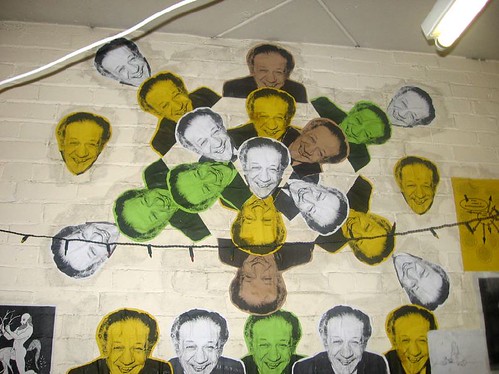
Fortran 5 painstakingly sampled Sid James to make him say the words of Bike by Pink Floyd. This was 1991. None of this was done by googling any samples, this must all have been from sitting there watching hour upon grinding hour of Sid James movies on VHS, occasionally exclaiming, "There! He said 'cloak'! Rewind it while I press record!".

There's an extra twist in the fact that the session was helmed by producer Stephen James, son of Sid. It was released on the B-side of the Groove EP, and later on the album Blues.

For their next project they moved a step closer to David St Hubbins territory, actually getting Derek Nimmo into a studio to sing Layla by Derek and The Dominoes. Genius.

download Bike (Sid Sings Syd) (7.8MB MP3)

16 November 2009

Wilson Pickett - Sugar Sugar & Cole Cooke and Redding mp3

Atlantic
45-2722
1970


Wilson Pickett - Sugar Sugar

Known to everyone for mid-60s belters like In The Midnight Hour, the late 60s found Wilson Pickett applying his gritty yawp to some unusual covers. The drawn-out anguish in his version of the Supremes You Keep Me Hanging On is just glorious.

More incongruous - and regular Dusters will know I'm a sucker for the weird shit - is his cover of Sugar Sugar, a bubblegum pop tune so twee the Monkees turned it down for being too cheesy, so it was released by a fictional band of cartoon characters, The Archies. It was the monster hit of summer 1969, and still high in the charts when Pickett gave it his solid soulful treatment. (For an equally unlikely take, check out Bob Marley's version, a Jamaican 45 that finally got worldwide release on The Complete Wailers box set).

For the B-side, Pickett did another bizarre recut. Abraham Martin and John was a late 1968 American hit for Dion, previously best known for turn of the 60s edgy-end-of-cleancut pop fare like Teenager in Love, Runaround Sue and The Wanderer. This song was quite different, a reflective ballad grieving the deaths of progressive public figures Abraham Lincoln, Martin Luther King and John Kennedy. The verse simply replaced the name in order to draw a sense of moral lineage between the three men, adding a fourth verse for Bobby Kennedy.

Has anybody here, seen my old friend John?
Can you tell me where he's gone?
He freed a lot of people, but it seems the good, they die young
But I just looked around and he's gone.

Here in the UK we best knew it as a top ten hit for Marvin Gaye, whose impeccable intelligent subtlety of phrasing and gliding molten chocolate voice perfectly suited the lyric's mix of stoicism and thoughtful melancholy. For reasons unknown (was Motown already showing a fear of Marvin getting into political ideas that would lead to such a battle to get the What's Going On album released?) this version was never released in the USA.

In his preamble to the song, Wilson Pickett credits Moms Mabley's then-current 1969 version as his inspiration. Pickett, however, remoulds it as a tribute to three giants of soul music who died young.

I have simultaneous contradictory feelings about it. On the one hand it's an inventive, touching and sincere nod from one soul singer to his antecedents, drawing on soul's gospel roots to address mortality.

Yet it also seems a tasteless belittling of the fact that dying of lung cancer, being shot in dubious circumstances or going in a plane crash aren't the same as being assassinated by reactionaries because of your political beliefs. You know Bob Dylan's comments at Live Aid about how it would be good if some of the money could go to help American farmers? It's a bit like that.

Whatever, it's certainly a great piece of vinyl era oddity, which is exactly what this blog's about.

download Sugar Sugar (4.3MB MP3)

download Cole Cooke and Redding (5.4MB MP3)

18 October 2009

The Spotnicks - Hava Nagila mp3

Oriole
45-CB1790
1963


The Spotnicks - Hava Nagila

Several years ago I had my musical gland squeezed in the middle of the night by a track played on Charlie Gillett's show for the BBC World Service. He was playing a selection of tracks that first made the West aware of other musics, antecedents for what we call world music. The one that made me sit bolt upright, switch the light on and write the details down so I could buy a copy was Soul Makossa by Manu Dibango. It has a couple of killer funk-soul hooks but with this great spacey loose funk groove that was unlike any of the American funk or soul I knew.

That was the clue that 70s soul wasn't just an American affair, that there was stuff around the world that would be every bit as rich, dirty and face-twistingly funky.

Earlier this year my dear friend the venerable Gyrus sent me a copy of Nigeria Disco Funk Special: The Sound Of The Underground Lagos Dancefloor 1974-79. Like most various artist compilations it's not of consistent calibre, but fuck me when the spectrum ranges from the good to utter riproarers that's no bad thing.

Then more recently I found this page of 70s Iranian funk. Who'd have thunk the funk would be out that far? The authorities banned pop music in the aftermath of the 1979 Islamic revolution, but it seems up till then there was some magnificent stuff being made and played in Iran. As an extra reason to hate their vicious regime, the Iranian funk page gives us a clue to what musical talent has been suppressed.

Weirdest of all is the version of Hava Nagila, a traditional Hebrew tune of celebration. Iranians doing an African-American style version of a Jewish tune. It'd be worth hearing just for the on-paper incongruous nutness of it, but play it and hear that it stands tall and firm on its own merits too.

This, in turn, sent me off to dig out the version I already have, an equally improbable early 1960s Tarantino style surf guitar version done by a Swedish band who wore spacesuits on stage.

The Spotnicks in their spacesuits

download Hava Nagila (3.4MB MP3)

04 September 2009

The Freshies - I'm In Love With The Girl On The Manchester Virgin Megastore Checkout Desk mp3

Razz (through MCA)
MCA 670
1980


The Freshies - I'm In Love With The Girl On The Manchester Virgin Megastore Checkout Desk

This fabulous piece of perky provincial powerpop faintly pestered the charts outside the top 40. Nice postpunk Skidsy guitars combine with 60s harmonies to give it a crisp playful momentum that matches the lyrics.

Mistakenly seen at the time as something of a novelty record, it's actually more the kind of indie wit that the Wonder Stuff would make a career of.

The lyrics are a fine documentation of that attitude, so common at the time but slightly mystifying now, that records were in and of themselves sacred and wonderful artefacts. And so, just like the way people disproportionately fancy bar staff due to some subconscious primal understanding of them as providers, we'd readily swoon at cool people working in record shops.

It takes the minimum of effort to have this song remind me of the woman who worked in Our Price in Southport. How I hoped she would be impressed by my pre-ordering cool records like Starfish by The Church. If she was, she hid it very well.

The Freshies continued that vinylophilic theme with their ploddy follow-up 45 I Can't Get 'Bouncing Babies' by The Teardrop Explodes.

But before that there was a problem to overcome with the Virgin Megastore single. This being the 1980s before everything was sponsored, and with the BBC putting masking tape over brand names when using cereal boxes to make stuff with sticky-backed plastic on Blue Peter, the namecheck in this single's title was a commercial hindrance. So it was recut as I'm In Love With The Girl On A Certain Manchester Megastore Checkout Desk. (Hear that version here).

Perhaps the rewording accounts for the words bring in the wrong order on this version's label ('Virgin Manchester Megastore' instead of 'Manchester Virgin Megastore').

Freshies mainman Chris Sievey later invented a Freshies fan, the staggeringly unfunny 'comedy' character Frank Sidebottom. Somehow he ended up doing Sidebottom for years on end, along the way spawning a cohort, Caroline Aherne's - who'd have thunk it possible - even less funny Mrs Merton character.

But never mind, because this single is such a glorious uplift.

download I'm In Love With The Girl On The Manchester Virgin Megastore Checkout Desk (4.1MB MP3)

26 May 2009

Lunar Funk - Mr Penguin Pt.1 mp3

Bell (USA)
45 172 (Bell 1225 in the UK)
1972


Lunar Funk - Mr Penguin

Over at one of my favourite blogs, The Quiet Road, Jim has posted a Youtube video of the Mothership Connection. I see no reason why we shouldn't let the funk seep on over to our place.

If, like me, you had never heard of this record before you saw a second hand copy, I sincerely hope you would feel as I did. Namely, any record called Mr Penguin by something called Lunar Funk has to be worth hearing.

Whilst it doesn't have the heavier sturm und thang delivered by some of their contemporaries, it grooves along with fuzzy guitar, trippy vibes and tricky rhythm.

Most importantly, it has what - as the venerable Adam Warne rightly observed - any track needs to be truly funky: a man with a deep voice saying funky stuff.

download Mr Penguin (4.1MB MP3)

If you're a funkafreak and want me to email you the Part 2 that appears on the B-side (pretty much another three minutes of the same), leave your email address in the Comments.

29 April 2009

Salford Jets - Who You Looking At mp3

RCA
PB5239
1980


Salford Jets - Who You Looking At

Dexys Midnight Runners' first album, a humid soul tangle, was brought to the limelight by the number 1 hit Geno. The second album, all that soul but with celtic folk sounds woven in, had it happen with the bigger hit Come On Eileen.

Then there was a huge wait before Don't Stand Me Down, a third album released with no flagship single and had them sat in corporate suits on the cover. It bombed. Yet it is every bit the equal of the first two, and in many respects excels them. A true lost classic.

To me, the giant on there is This Is What She's Like, one of the most extraordinary and brilliant love songs I've ever heard. A twelve minute epic, the lyric is a conversation, one party asking what 'she' is like and the other trying to explain. But he does it with non-verbal phonetics as words fail him.

Before that, he tries by listing a lot of disparate, curiously specific things that she's not. All those things that annoy, the things that denote people who are clueless and hopeless at root, things that make you want to give up on people, things that 'she' is such a refreshing change from.

Well you know how the English upper classes are thick and ignorant?

You know the newly wealthy peasants with their home bars and hi-fis?


People who describe nice things as wonderful.

And, first on the list, the kind of people that put creases in their old Levi's.

Imagine the level of tosserliness required to do it to the extent that your jeans have a discernible lightening down those creases. Ladies and gentlemen, I give you the Salford Jets.

Salford Jets EP cover

I find it heard to believe the crease could be lightened by mere ironing. What did they do, delicately paint down their kecks with a bleachy cotton bud?

The EP pictured is a 1979 collection of I Want To Hold Your Handish beaty pop, with an arrow logo and a couple of skinny ties to cash in on the waning mod revival.

Fed Up of Stalybridge had the main letter in last Thursday's Manchester Evening News. They complained young people had abused them in the street.

Such hostility to strangers is, they assert, getting 'increasingly common'. 'Have people always displayed such an aggressive "watchoo lookin at?" attitude?'

Manchester Evening News letter

To answer that question let us welcome back Greater Manchester's all-time most negligible band. Ladies and gentlemen, once again I give you the Salford Jets.

The year after the EP they released a single of breathtakingly brainless, affected spilt-pintery. Scraping into the charts at number 72, Who You Looking At? features two verses and a chorus of cod-punk twaddle. They even drift into that Estuary English accent so essential for pseudo-punk.

Who you looking at
When you're walking down the street?
Who you looking at?
You better not be looking at me
I said who you looking at?
Who you looking at?
Who you looking at?
It better not be me


Fractionally redeemed by a brief tasty organ break, nonetheless it's one of the most ludicrous, risible records ever manufactured.

download Who You Looking At (3.1MB MP3)

02 April 2009

Seventeen - Bank Holiday Weekend mp3

Vendetta
VD001
1979


Seventeen - Bank Holiday Weekend

I said in an earlier post that I couldn't remember if I'd seen The Alarm in December 1985. Well, for those of you who who've bitten their nails to the quick awaiting an answer, relief is at hand.

A rummage around brings to light the ticket stubs. Saw them in November 84 (I remember hitch-hiking home and listening to the American election results on the radio. Reagan re-elected. Fuck.)

ticket stub, The alarm, Liverpool University, 6th November 1984

And again the following May.

ticket stub, The alarm, Liverpool Royal Court theatre, 1st May 1985

With another tour in December they certainly weren't slacking. And they undoubtedly did really good gigs, but by late 1985 my interest in them had waned. They were becoming a bit too straightforward, a bit - as it was known at the time - rockist.

They'd come through a couple of years earlier with several bristling singles and an aptly titled confident and earnest debut album, Declaration.

Lyrically they had broad-brush politics about justice, hope and the concerns of the ordinary person, a gift for terrace-anthem choruses, and a specific obsession with war imagery (soon adopting a splattery poppy as their logo).

Musically they had real gusto yet tempered it sonically with sweeping layers of strident acoustic guitars and emotionally with a melancholy tint.

The sound was thus intricate yet epic, bold and provocative yet ornate and even wistful, it could curl like a creeper vine or explode as big and startling as their hairstyles.

The Alarm

If you could repress your cynicism - or had yet to form any to speak of - then they were fresh, exciting and involving. I still stand by that first album as being all those things.

Though I'd personally lose interest as my tastes went a little toward darker and more oblique music (REM, The Church), at least The Alarm didn't go as dull as Big Country. And you've gotta respect a band that would cut their fourth album, Change, in two different vocal versions, one in English and one in Welsh. Especially a band from as anglophone a part of Wales as Rhyl.

But let's let the screen go into that heat-haze effect that tells you it's a flashback.

Before they were The Alarm they were a post-new wave mod band called Seventeen. Taking that Merseybeat brightness with a bit of solidly chuggy new-wave guitar, like The Members or The Chords or the Lambrettas, only they don't seem to have been as good as those ones. Who, in turn, weren't that good themselves.

(Before this, incidentally, singer Mike Peters was in a punk band called The Toilets. Worth doing it just for the name I reckon).

Seventeen issued a single, both sides written by the future Alarm mainstay team of MacDonald and Peters. The A-side was Don't Let Go, but it's the B-side, Bank Holiday Weekend, that catches my ear. You can see them trying to latch on to the mod iconography of bank holiday punch-ups on Brighton beach, but as its fifteen years later and they actually live in a seaside town they know that the truth is somewhat different. Bored families, tacky tat for sale, the deflation of something looked forward to being dull.

I've no idea, but I'm guessing this was their only release and quite possibly a DIY job, given that it has the catalogue number VD 001. I love that prefix. When I was in a band, our fake record company for what turned out to be our only release was Rampant Records, letting us use PANTS 001. You've got to take the opportunities for smut where you find them.

There's no clue at all that these people would go on to do anything of worth. In that way, it's opposite of the Johnny and the Self-Abusers single (a piece of slinky arty punk that, after a namechange to Simple Minds, gave way to one of the most vacuous and execrable careers in the history of eardrums).

download Bank Holiday Weekend (4.4MB MP3)

By the way, if you're some Alarm completist gagging for the MP3 of Don't Let Go as well, leave your email address in the Comments and I'll send it to you.

11 March 2009

Tom Robinson - Never Gonna Fall In Love (Again) mp3

EMI
EMI2967
1979


Tom Robinson - Never Gonna Fall In Love (Again) picture cover

I found this in Oxfam in Headingley circa 1993. I knew Tom Robinson's raised fist classics (2468 Motorway, Glad To Be Gay) and the more thoughtful mysterious side (War Baby, Atmospherics), and that he'd just returned to form as an acoustic troubadour with a new batch of songs with his trademark mix of biting cynicism and warm hearted optimism.

But nothing prepared me for what I was about to receive. It's a smirky saucy swirly gay disco track with a hands-in-the-air chorus. This bright shiny setting is a great juxtaposition for Robinson's dry throaty vocal tone.

Never meant to be so friendly
Never made the room look nice
Never heed a word of warning
Never take my own advice
Ooh, I got a brand new problem
He's pretty and he's five foot ten
I've been in love three times this week
I'm just about to fall again


In a 2004 interview for the excellent radio show and online resource Queer Music Heritage, Tom said

In many ways one of my favorite gay songs of all the ones that I wrote that had a specifically openly amorously gay theme, I like "Never Gonna Fall In Love Again" because I sent the lyric to Elton John and he came back with the music for it, and so it was a collaboration between two gay artists. And he is a great songwriter, there's no question, so it's got good changes and a decent melody. And his version of course was a slow ballad and…a bit drippy to be honest.

And although he sent me back a demo which had all the pronouns as I'd written them, when he recorded it himself he kind of slurred them a bit, so where it's "I wish he didn't make me rabid" his is "I wish-he didn't make…" you know it was just a little bit on the ambiguous side.

Ah, but that's all right. That's where he was at the time and what Elton has done (A) for the gay movement, and (B) in the fight against AIDS, with the Elton John AIDS Foundation, you know, is fantastic and we owe a huge debt to the man, so I think he's allowed to slur a few of his pronouns here and there


A wild collision of talents, it's not only co-written by Tom Robinson and Elton John, but produced and engineered by Nick Drake's guy John Wood, and mixed by Sex Pistols producer Bill Price.

To make it stranger still, while the B-side is credited to Tom Robinson Band, the A-side is 'Tom Robinson With The Voice Squad'. Who might this shady group be? Er, it's the Tom Robinson Band.

According to Tom's official site

Although TRB were playing on the record, its hamfisted disco style was so alien to what the band was about that at the other members' request it was released as a Tom Robinson solo single and the group split shortly afterwards.


Robinson didn't let his step falter, swiftly putting on a solo gig of gay songs to mark the tenth anniversary of the Stonewall riots. That show was released as the Cabaret 79 album which, generous gent that he is, is available for free download from his site.

Whilst Never Gonna Fall In Love (Again) is not disco proper - crank it up and there's no Chic-esque bass whoomf - it's a great piece of perky cheeky pop-disco and a real unexpected delight.

download Never Gonna Fall In Love (Again) (4.6MB MP3)

The single donated all performance royalties to London Gay Switchboard, which is still very much in action. If you download the MP3, why not make a donation? Just £1 covers the cost of a ten minute call.

26 February 2009

The Charles Randolph Grean Sounde - Star Trek mp3

Ranwood (USA)
R1044
1975


The Charles Randolph Grean Sounde - Star Trek

The Star Trek theme.

Disco version from the mid-1970s.

Oh yes indeed.

download Star Trek (5MB MP3)

11 February 2009

Faith Brothers - Easter Parade mp3

Siren
SIREND2
1985


Faith Brothers - Country of The Blind cover

Over on my other blog I did a post about going to see the hybrid reunion-tribute band From The Jam.

In digging around to find old gig tickets from the 80s with which to illustrate it, I found this old listings flyer from 1985.

forthcoming gigs flyer, Royal Court theatre, Liverpool, 1985

I love the way bands are expensive in proportion to how long they've been going, and almost in inverse proportion to how good they are.

The cheapest gig on the list and the only one I went to was REM (with the possible exception of The Alarm, saw them a couple of times, can't remember if that Royal Court gig was one). REM's listed support act, as with a ton of gigs at the Royal Court around that time, was the Faith Brothers.

As Sly and Robbie told Michael Franti, reggae isn't a nationality, its a rhythm and it belongs to everyone. In the same way, soul is what you play and what you are, not where you're from.

The Faith Brothers were, like Immaculate Fools, a band who got a mid-80s Big Push from their record company (Virgin, using their Siren imprint) with a double-pack single, Country of The Blind.

They packed a political punch in bright bouncy soul and, despite the universality of musical styles, there was nonetheless something a little arch and polished, just a smidgen of The Commitments in them.

Still, coming out in the year of the miners strike as Thatcher's talons dug into the fabric of society, anything that proclaimed compassion with passion was welcome.

Tucked away on that extra single, Easter Parade is a world apart from the mainstay of their brass-augmented soul kick. Clearly written for just one acoustic guitar, it's propelled by Billy Franks' driven sincerity and - quite an achievement for the mid-80s - is given a subtle and haunting production job, doing justice to its subject, the six week long Falklands War of 1982.

It tells the story from the perspective of a soldier and, unusually for lefties of the time, it has sympathy not only with his injuries but also with him being there in the first place.

Dressed to kill one cool spring morning
Got on board the first from Portsmouth
On the crest of a rising wave
Of hate for strangers of our own kind
But the headlines, cheering crowds and flags
I must admit stirred something in me
That faded as we pulled away
And turned out to be only fear disguised

The bulldogs bayed
The pious prayed
I think it rained
On the Easter Parade

Down south the old and desperate men
Sacrifice the young and ready
On the altar of their crumbling gods
Mourning for a long-lost glory
For nineteen years you chart my life
With your morals and your incentives
In six weeks pull it all apart
For horror's real and you are far away

My mind ingrained
I came home maimed
So was kept away
From the Easter Parade

Hooked on a kind of freedom
I still need to hurt somebody
Too estranged to talk about it
Or get close to anyone

The mother of the nation cries 'Rejoice!'
And I can hardly shuffle
Struck down by what the mean can do
For political ambition
And now the truth begins to surface
Like a spectre from dark water
Rising up to bring them down
I can't take heart, only wonder why

Is our conscience lame
Is a fall to shame
All to be gained
From the Easter Parade

= = =

'The headlines, cheering crowds and flags I must admit stirred something in me'

As the ships sailed from Portsmouth for the Falklands there were vast crowds of union jack waving crowds. In these times of the ongoing unpopular wars of occupation, it's hard for people to realise how much we were still in thrall to jingoistic flag-waving bullshit back then. These days, saved for occasions like the football, it's lost much of its arrogant imperialist overtones.

It's surprising how the atmosphere has changed in a relatively short time. 1982 was only five years since the queen's silver jubilee, an occasion marked by public holidays and everything. I know of people who grew up in fervent Welsh nationalist households who still had a street party with red whit and blue bunting.

Yet look how underwhelming the celebrations for the golden jubilee were in 2002. Anyone over the age of five in 1977 remembers the silver jubilee, yet none of us can remember anything about the golden jubilee without looking it up.

As Thatcher talked to the press when the Argentinian forces had surrendered, you can hear the crowd in the background singing Rule Brittania.

That refrain 'rule Britannia, Britannia rule the waves, Britons never never never shall be slaves' has a much more sinister meaning than first appears. Written in 1740 as the slave trade was peaking, with Britain the foremost slave-trading nation, it is not a song about our liberation. It is a song that declares our superiority over all others and that we shall never suffer the kind of slavery that we inflict.

'The mother of the nation cries 'rejoice!' and I can hardly shuffle'

On 26 April 1982 Thatcher stood outside 10 Downing Street as the Defence Secretary announced the recapture of South Georgia. Afterwards, she refused to answer questions, telling the press to just 'rejoice at that news'.

'I came home maimed so was kept away from the Easter Parade'

The jaw-dropping cynicism of Thatcher's victory parade still angers me today. It was to be an overtly jingoistic celebration. Troops who had fought were to march along with their bayonets fixed and buttons gleaming. Except the ones who'd come home with unsightly injuries. They - the ones who'd given the most for the cause - weren't invited in case they spoilt the jubilation with the horror of truth. After a media furore, some were belatedly asked along.

There are still resonances now. Even though we no longer have so much patriotic poppycock about our wars, we are manipulated. The American government makes sure their electorate don't get too riled by what happens to their troops. Just as Thatcher barred maimed Falklands veterans, there are no pictures allowed of American coffins and bodybags coming home from Iraq. Around a third of American troops in Iraq aren't American at all, they're foreigners who will get fast-tracked for American citizenship if they come back alive, thus reducing the pressure on American public opinion.

Timed for the autumn before a general election, the Falklands victory parade pushed Thatcher's popularity higher. It was calculated to do so - she took the salute of the troops, a job normally reserved for royalty.

The Labour party had just split (four senior members setting up the Social Democratic Party, which eventually merged with the Liberals to form the Liberal Democrats), and with it the Labour vote was divided. Thus a prime minister who came to power on a ticket of law and order and lowering unemployment yet presided over the worst rioting in living memory and a trebling of the number of jobless managed to get re-elected with the biggest landslide in 40 years.

Labour's bold manifesto - unilateral nuclear disarmament, nationalise the banks, abolish the House of Lords - and the fact that, in Michael Foot, they had the most untelegenic leader imaginable was blamed for their defeat, rather than the war and the fucking SDP.

A dashing charismatic young Labour candidate who entered parliament on that manifesto would sweep to power in 1997 on a pro-Trident pro-privatisation ticket. His successor entered parliament at that same election, and whilst he's done a little nationalising of banks under duress, he's still yet to make good on the promised House of Lords reform.

The musical lift into the bridge of the song ('hooked on a kind of freedom...') still catches the pit of my stomach every time like a rollercoaster, which is fitting for the words that allude to the personal disconnection, to what was then only just starting to have a name as post-traumatic stress disorder.

'And now the truth begins to surface like a spectre from dark water'

On 2nd May 1982 the Argentine ship Belgrano was sunk, killing over 300 men, around a third of the total killed in the war. The ship was outside the 200 mile exclusion zone around the Falklands and was sailing away at the time. In July 1984 a senior civil servant leaked documents proving the government knew this, and the ship had been spotted a day earlier than claimed.

The civil servant, Clive Ponting, was prosecuted under the Official Secrets Act. His defence was that it was in the public interest to know the truth. The judged begged to differ, telling the jury 'the public interest is what the government of the day says it is'. Despite this the jury - being the public rather than the establishment - acquitted him. It was in this atmosphere that Faith Brothers frontman Billy Franks wrote Easter Parade.

Sadly, it was not the start of a flood of leaks on government lies, and Thatcher responded with a new Official Secrets Act that doesn't have a 'public interest' defence.

Truths still come out occasionally, though. In 2003 the government finally admitted that nuclear weapons had been on warships in the Falklands.

Clive Ponting resigned from the civil service and became an academic and a history author, writing a number of books including a critical biography of Winston Churchill and the classic Green History of The World, recently revised and expanded as A New Green History of the World. Check out this excerpt, The Lessons of Easter Island.

Billy Franks has continued songwriting, seemingly as committed and passionate as ever.

download Easter Parade (5MB MP3)

08 January 2009

Johnny Johnson & His Bandwagon - Mr Tambourine Man mp3

Bell
BLL 1154
1971


Johnny Johnson and His Bandwagon - Mr Tambourine Man

Tony Macaulay was one of the great British bubblegum songwriters of the 60s and early 70s, but he was obviously in thrall to Motown and usually put a dose of soul in the mix to leaven the sweetness.

His first major hit - he was only 23 and had written the song two years earlier - was Baby Now That I've Found You by The Foundations, and then a year later Build Me Up Buttercup. In between there were a couple of singles you're less likely to have heard of, of which I strongly recommend Back On My Feet Again, another sunny stomper cut from the same cloth as the biggies.

He wrote a bunch of other singles in the same wide-eyed catchy bouncy vein usually recorded by non-existent bands such as Edison Lighthouse's Love Grows Where My Rosemary Goes.

Meanwhile, at the same time as Build Me Up Buttercup, there was a punchy pop-soul band called The Bandwagon in the charts with Breakin' Down The Walls of Heartache. Subsequently something of a northern soul staple and covered by Dexys Midnight Runners on the B-side of Geno, this corker was released on the CBS imprint Direction.

The Bandwagon - Breakin' Down The Walls Of Heartache

You just know from the name and artwork that the label's a winner. Any time you see a single on Direction, unless it's a piece of Sly Stone perfection, it's something you've never heard of. And yet, if you like the tang of some later northern soul urgency, it rarely disappoints. If you come across anything on Direction, always give it the benefit of the doubt and buy it.

The talents collided in Love Grows' year 1970 with Macaulay writing and producing the (now 'Johnny Johnson and His...') Bandwagon hits Sweet Inspiration and Blame It On The Pony Express as the flagship singles for the Soul Survivor album.

The following year there was this single. You've got a real soul band and a bubblegum producer at the helm, so whether you're thinking Byrds or Bringing It all Back Home it's a scarcely recognisable version of Mr Tambourine Man. Bright, bouncy, brilliant and a bit baffling, it's a fabulous little corner of pop weirdness.

Later in the 70s Macaulay teamed up with another British bubblegum mainstay, Roger Greenaway, to do You’re More Than a Number in My Little Red Book and Kissin’ in the Back Row of The Movies for the Drifters.

Then he swapped soul for Soul, writing and producing Don't Give Up On Us, Silver Lady and other fucking awful sickly syrupy shite for the Starskyless Hutch gone dewy-eyed romance singer David Soul. They sold gazillions and clutter up charity shops to this day.

download Mr Tambourine Man (4.4MB MP3)

07 November 2008

Millie - My Boy Lollipop (German) mp3

Fontana (Germany)
267376TF
1964


Millie - My Boy Lollipop (German picture cover)

Millie Small recorded a load of stuff (including one of only two Nick Drake covers recorded during his lifetime, an inexplicable take on Mayfair), but it's this utterly perfect two minutes that she'll always be best known for.

It's the song that brought ska to global attention, a delightful skippy groove with a harsh slap of a production.

When I'm DJing I keep My Boy Lollipop and Superstition separate and always visible. If ever I paint myself into a corner or summat's floundering and flagging, I throw either of them on. They set themselves completely apart from any tune you may have just played, and they are utterly incendiary to a dancefloor.

This isn't the version you know, mind. It is, as the sleeve proudly proclaims, the Deutsche Originalaufnahme.

Unlike others who sang versions of songs entirely in German, Millie veers randomly between that language and her native English. This, though, only serves to make it all the weirder.

Corker.

download My Boy Lollipop (German version) (2.9MB MP3)

26 October 2008

The Wasters - Accept My Love & Don't Stop mp3

Uni (USA)
55148
1969


The Wasters - Accept My Love

I know absolutely nothing about this band, but what does that matter when the music is sooooo good?

They have a mix of early 60s sweet soul vocals with a late 60s warmth underneath, something about the way bass amps have been invented bringing proper bottom end on to records, but there's much more, a gorgeous summery sweep with outstretched arms that exalt and uplift.

Although the vocals do remind me of early Smokey Robinson and even earlier rich romantic doo-wop groups like the Five Satins, there's also another foot in the Stylistics-style 70s soul.

Accept My Love is a melty ballad that swoons and languidly sparkles, but the one that really really gets me is the flip, Don't Stop. You wouldn't believe how many times in a row I get compelled to play this sucker.

Loose wah-twangs droop and snag around a brass punch and a gossamer funky beat, late 60s Northern Soul at its irresistible best. Turn it up and let your feet show you what they were made for.

[MP3s deleted to make way for new ones. Sorry! See 'Deleted Tracks' in the sidebar if you'd like these tracks emailing to you]